
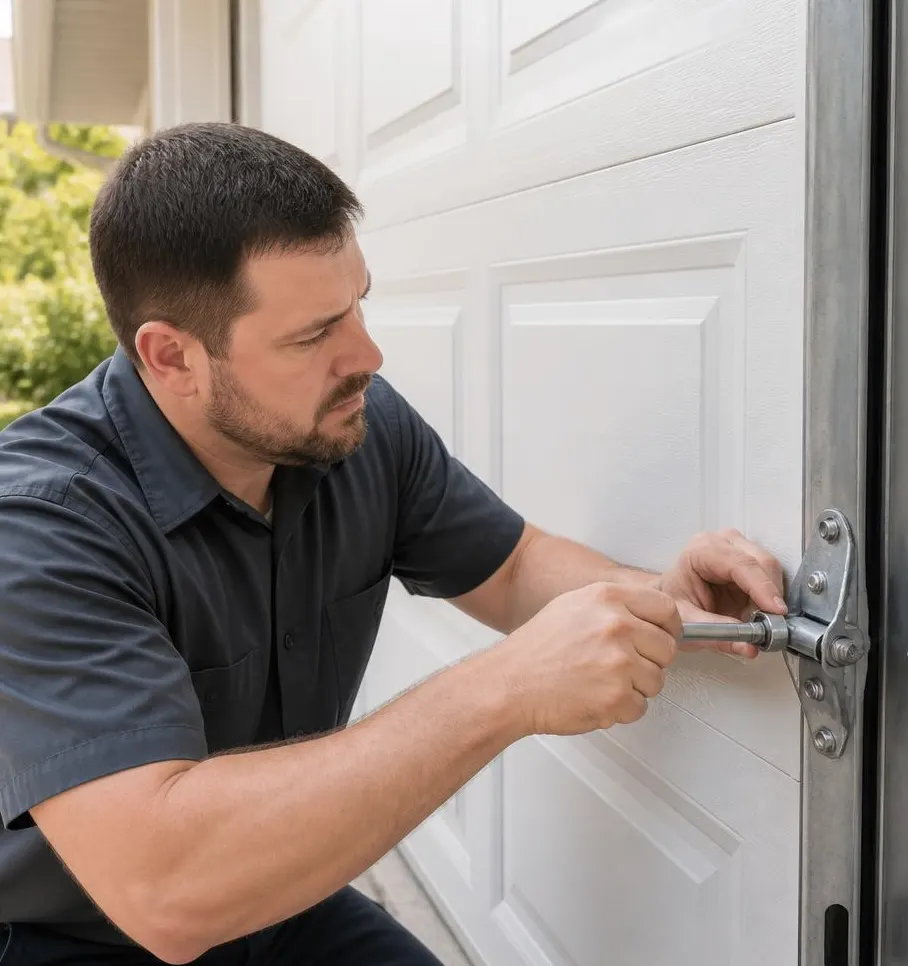
The Morning It Won't Budge
You hit the opener button on your way to the car and the door groans, lifts an inch, and stops. Or it rises in jerky pulls instead of one smooth motion. Maybe the opener motor strains and clicks but the door barely moves, or it opens fine and then slams back down the second it touches the floor. After one of Wilmington's rare ice mornings or a damp cold snap following a few days of rain, this is one of the more common calls we get. The door isn't broken in the dramatic sense — something is binding it, and the cold is either the cause or the thing that exposed a problem that was already there.
Symptoms Worth Noting Before You Call Anyone
- The door is physically stuck to the garage floor and won't lift at all, even manually.
- It moves slowly or unevenly, rising faster on one side than the other.
- The opener motor sounds like it's working harder than usual — a strained hum or repeated clicking.
- The door reverses on its own shortly after closing, as if something is in the way.
- There's visible frost, ice, or a wet sheen along the bottom seal or tracks.
Write down which of these match your situation. It helps narrow things down fast, whether you're troubleshooting yourself or describing it to a technician over the phone.
Cause #1: The Bottom Seal Is Frozen to the Slab
This is the first thing any technician checks, because it's the most common and the easiest to misdiagnose as a motor problem. If the weather dipped near freezing overnight after rain or heavy condensation — which happens along the Cape Fear coast more than people expect, even without a hard freeze — a thin film of water under the rubber seal can ice over and glue the door to the concrete.
The fix: Don't force the opener; repeated attempts can strip gears or snap the trolley. Pour warm (not boiling) water along the seal line, or use a hair dryer on low heat to loosen the bond, then try lifting manually before using the opener.
Cause #2: Stiff or Cracked Weatherstripping
Vinyl and rubber seals harden in cold temperatures, and if the seal is already a few years old — brittle from Wilmington's summer UV and humidity cycles — cold weather is often what finally makes it crack or stick to the floor instead of flexing away from it.
The fix: A technician inspects the seal for cracking or flattening and replaces it if it's no longer pliable. This is inexpensive and often solves the sticking issue permanently, not just for one cold morning.
Cause #3: Spring Tension Thrown Off by the Cold
Metal contracts slightly in cold temperatures, and torsion springs can lose a bit of lift capacity when the mercury drops. A door that was perfectly balanced in October can suddenly feel heavier in a cold snap, which shows up as the opener straining or the door moving unevenly.
The fix: This is a job for a trained technician only — springs are under serious tension and adjusting or replacing them without the right tools is genuinely dangerous. A tech checks balance by disconnecting the opener and testing the door manually, then adjusts or replaces the spring as needed.
Cause #4: Dried-Out or Sap-Gummed Lubrication
Cold thickens lubricant, and if the rollers and hinges were already due for fresh grease, winter is when that shows up as grinding or resistance. Garages near pine trees also deal with sap residue mixing with old lubricant, creating a sticky film that gets stiffer in cold weather.
The fix: Clean the rollers, hinges, and track with a dry cloth, then apply a silicone-based garage door lubricant — not WD-40, which attracts dust and doesn't hold up long-term.
Cause #5: Opener Force Settings Out of Calibration
If the door reverses right after closing, the opener's force or limit settings may need recalibration. Cold-weather stiffness in the springs or rollers can make the door harder to close, which trips the opener's safety sensors.
The fix: A technician recalibrates the force and limit settings only after confirming the mechanical issues above are resolved — adjusting settings to compensate for a binding door just masks the real problem.
Cause #6: Track Misalignment from Moisture and Corrosion
Humidity and heavy rain — not uncommon here even in the cooler months — can lead to slow corrosion or slight shifting in the tracks over time. Cold makes the metal contract just enough to turn a minor misalignment into a binding point.
The fix: Track realignment, and in older systems, replacement of worn rollers that no longer glide smoothly.
When to Call Precision Garage Door of Wilmington
If your door is sticking, straining, or reversing and a warm-water thaw doesn't solve it, it's time for a proper inspection. Our team handles everything from Spring Repair & Replacement to full Garage Door Maintenance tune-ups that check seals, lubrication, balance, and opener calibration in one visit — the same sequence a technician works through on a cold-weather service call. Catching it now, before the next freeze or the next ice storm, is a lot cheaper than replacing a stripped opener motor later.
If your garage door is fighting you this winter, call Precision Garage Door of Wilmington and we'll get it moving smoothly again — fast, honest service for homeowners across Wilmington, NC.